His debut feature from 2005 established him internationally, traveling widely through festivals and earning major awards in Rotterdam, Buenos Aires, Seattle, Athens, and Transylvania.
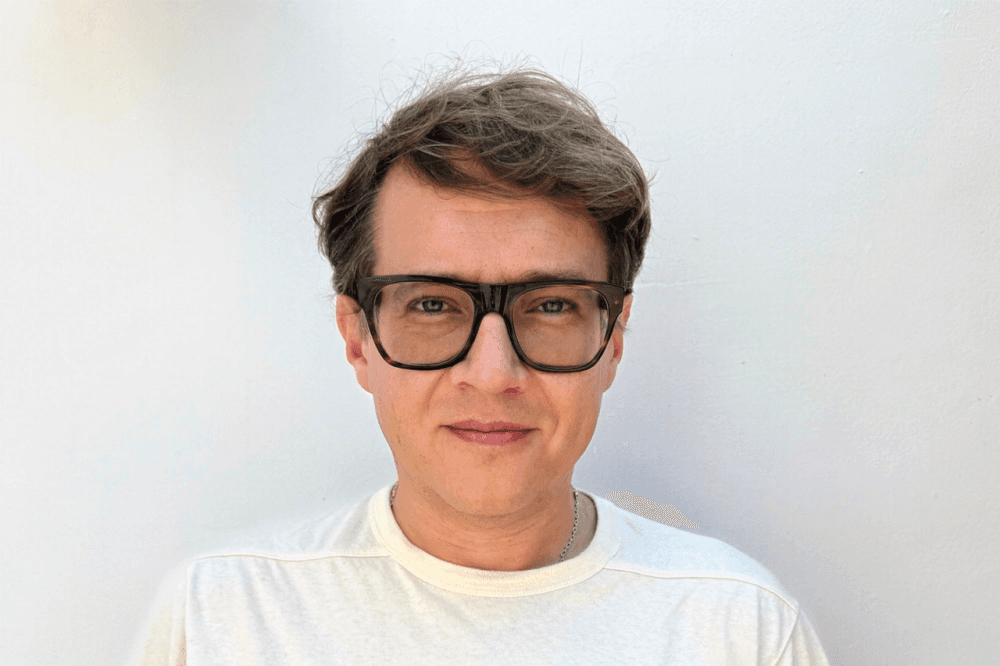
Film Director, Artist,
and Producer.
Member of the European Film Academy.
Born in 1975 in Moscow, Ilya Khrzhanovskiy grew up in the family of the animation director Andrey Khrzhanovskiy and the philologist and script editor Maria Neyman.
He studied at the Bonn Academy of Fine Art and graduated from the Russian State Institute of Cinematography (VGIK) in 1998.
Since 2006, he has lived and worked between Germany, Ukraine, Israel, and the UK.
His work moves between cinema, contemporary art, and long-form multidisciplinary projects, often bringing together film, performance, architecture, and research.
He is currently working on new media and art projects focused on the development of new forms in contemporary art and cinema.
Cinema
Khrzhanovskiy's film work moves between concentrated feature filmmaking and projects that stretch cinema into space, duration, and lived environments.
His debut feature, 4 (Four), established him in the international festival circuit, while DAU became a long-term multidisciplinary undertaking developed across film, architecture, performance, and research.
In 2025, he founded IP Filmworks in France with Philippe Bober.
His second production expanded cinema into a long-term environment shaped by film, architecture, performance, and anthropology, with its first public release unfolding across Paris in 2019.
The new DAU film, selected for the Competition programme of the Venice International Film Festival in 2026.
News
- Venice Film Festival: DAU in Competition. DAU selected for the Competition programme of the Venice International Film Festival, 2026.
- Sarajevo Film Festival: Tribute To: Ilya Khrzhanovskiy. Guest of honor of the Tribute To programme at the 31st Sarajevo Film Festival, August 2025.
- SMAC Venice: DAU. The Quantum Effect. Participation in the exhibition at the San Marco Arts Centre, Venice, September–November 2025.
Memory & Architecture
From 2020 to 2023, Khrzhanovskiy served as Artistic Director of the Babi Yar Holocaust Memorial Center in Kyiv. That work brought together memorial architecture, installations, research, and film.
Alongside the memorial projects, he has also worked as a co-producer on documentary films by Sergei Loznitsa. He co-founded Phenomen Ukraine Ltd. in 2009, Phenomen Berlin Filmproduktions GmbH in 2010, and Phenomen UK Ltd. in 2011.
An overview of Babi Yar, memorial projects, co-productions, and institutional work.
A closer look at the installations and memorial structures developed in Kyiv from 2020 onward.
Public Life
In recent years, his public life has been shaped by an outspoken anti-war position, by work on the memorial project Closed Eyes, and by a series of personal and professional decisions made after Russia's full-scale invasion of Ukraine.
In 2024, the Russian Ministry of Justice added him to the list of foreign agents in Russia, and later that year he refused Russian citizenship.
Public statements, anti-war actions, and recent milestones.
The online memorial documenting civilian victims of the Russian-Ukrainian war.
Press & Interviews
- The Guardian: Interview on exile, DAU, and the war in Ukraine. A recent long-form conversation that connects cinema, public life, and displacement.
- Time Out New York: On the release of 4. An early response that captured the unsettling force of the debut feature.
- The New York Times: On the opening of DAU in Paris. A report from the moment DAU first became public as both cinema and environment.
- Apparatus: DAU Is a Process. A detailed conversation about method, duration, and the logic of the project.
- The Film Stage: On DAU. Natasha. Festival coverage focused on the first film through which many viewers entered the DAU cycle.